
Lumbar Herniated or Bulging Discs
Disc material may irritate or compress a nearby nerve root, contributing to radiating pain, tingling, or numbness.

JUST
REGULAR VALUE $240 — SAVE $151!
Regular Value: $150
Comprehensive chiropractic examination
Review of findings and personalized care recommendations
Initial chiropractic adjustment, if clinically appropriate
Regular Value: $90
Professional 60-minute Swedish massage
Scheduled as a separate appointment
TWO VISITS. ONE PRICE. JUST $89!
New patients only. Both appointments included for $89. No additional charge for advertised promotional services. No obligation to purchase ongoing care. Medicare beneficiaries and individuals covered by federal healthcare programs, including Medicaid, TRICARE, and CHAMPVA, are not eligible. No insurance billing for this promotion.
A sharp pain shooting down your leg. Burning or tingling in your buttock. Numbness that makes sitting, standing, or driving uncomfortable.
Sciatica can interfere with almost every part of your daily routine.
35+ Years of Experience
Chiropractic Care
Flexion-Distraction Therapy
Personalized Treatment
At Lauterbach Chiropractic, Acupuncture & Massage, we help patients experiencing sciatica and related lower back conditions understand their symptoms and explore appropriate conservative treatment options.
With more than 35 years of clinical experience, Dr. Ed Lauterbach provides individualized chiropractic care for patients throughout Palmyra, Lake Monticello, Fluvanna County, Louisa, Zion Crossroads, Charlottesville, and surrounding Central Virginia communities.
Our goal is to help reduce discomfort, improve mobility, and support your return to everyday activities.
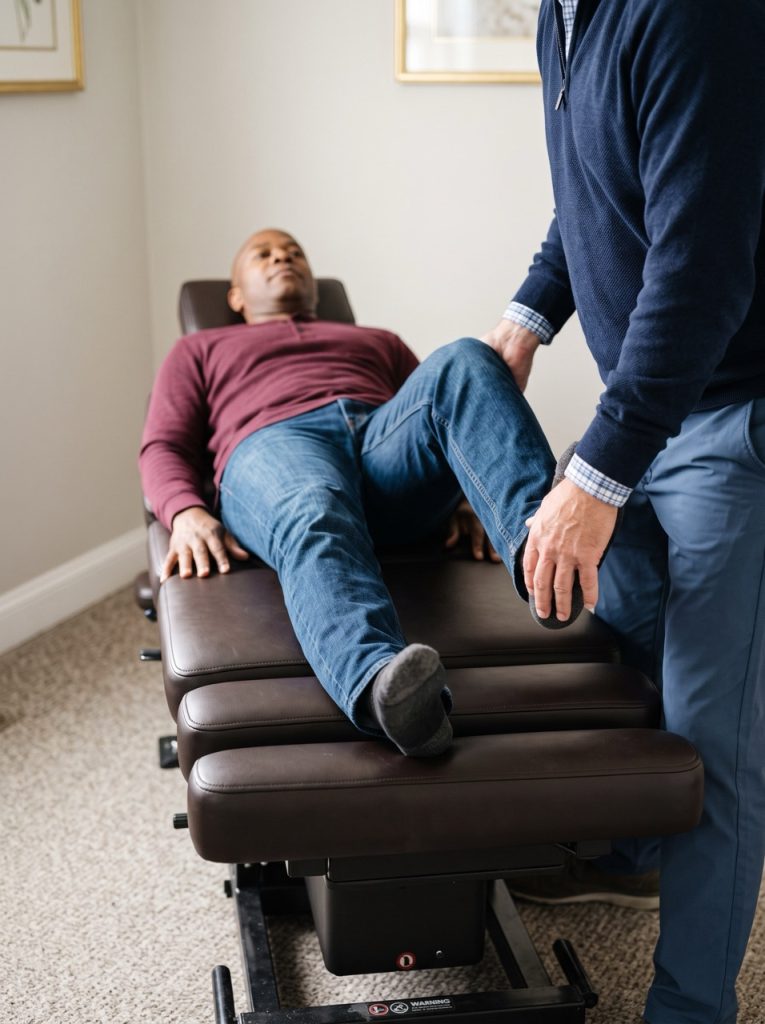
Understanding Pain That Travels Down Your Leg
Sciatica refers to symptoms associated with irritation or compression of nerve roots that contribute to the sciatic nerve.
These nerves originate in the lower spine and travel through the pelvis and into the lower extremities.
Sciatica commonly affects one side of the body, although symptoms and patterns vary.
Common symptoms include:
Sharp, shooting, or burning pain extending from the lower back or buttock into the leg.
Tingling or pins-and-needles sensations.
Numbness affecting part of the leg or foot.
Pain aggravated by prolonged sitting or certain movements.
Discomfort with bending, lifting, or walking.
Muscle weakness in some cases.
You can experience sciatica even when your lower back doesn’t hurt very much.
Common Causes of Sciatic Nerve Symptoms
Several conditions can irritate or compress the nerve roots in the lumbar spine.
Disc material may irritate or compress a nearby nerve root, contributing to radiating pain, tingling, or numbness.
Narrowing of spaces around spinal nerves can cause leg symptoms, sometimes becoming more noticeable during standing or walking.
Age-related changes involving discs and joints may contribute to narrowing around nerve structures in some patients.
A vertebra that has shifted relative to another vertebra can sometimes affect nearby nerve structures.
Muscle-related referred pain, hip disorders, and peripheral nerve conditions may mimic sciatica without involving a lumbar nerve root.
More Than Just an Adjustment
Sciatica requires careful consideration of nerve-related symptoms, spinal findings, and potential warning signs.
Dr. Lauterbach evaluates your history, movement, relevant neurological findings, and functional limitations before recommending care.
When conservative management is appropriate, treatment options may include:
Selected patients may benefit from chiropractic manipulation or mobilization to address associated spinal joint discomfort and mobility limitations.
The approach is adapted to your examination findings, symptoms, and tolerance.
Flexion-distraction is a specialized chiropractic technique using a treatment table to apply controlled movement and distraction to the lumbar spine.
It may be considered for certain patients with lower back pain and selected disc-related or radiating leg complaints.
Dr. Lauterbach evaluates whether this technique is suitable for your individual condition.
Our office offers spinal traction and decompression techniques that may be considered in selected cases.
These approaches are not appropriate for everyone, and evidence of benefit for sciatica varies. Treatment does not guarantee relief of nerve compression or reversal of disc changes.
Massage may help address accompanying muscle tension and soft-tissue discomfort in the lower back, hips, or surrounding areas.
Massage does not directly correct spinal nerve compression.
Acupuncture may be considered as an additional option for certain pain-related complaints. Its effectiveness for sciatica specifically remains uncertain.
When myofascial trigger points contribute to accompanying muscular discomfort, dry needling may be considered.
Cold laser therapy may be offered for selected musculoskeletal complaints, although evidence for treating nerve-root-related sciatica is limited.
Appropriate activity modification and individualized movement advice can be important components of conservative management.
Not every patient requires multiple treatments. Recommendations depend on your condition, preferences, and clinical response.
Why the Correct Evaluation Matters
Not all leg pain is sciatica.
Often involves radiating pain, tingling, numbness, or weakness following a pattern associated with lumbar nerve-root irritation.
Muscle tension or trigger points in the lower back and hip region may produce discomfort extending into the buttock or thigh.
Certain hip disorders can cause groin, buttock, or thigh pain that may be confused with spinal symptoms.
Nerve irritation outside the spine can cause tingling, numbness, or pain in the leg or foot.
Your history and examination help determine the most appropriate next step, including referral or further testing when necessary.
Understanding Your Symptoms Comes First
We’ll discuss where the pain begins, how far it travels, what makes it worse, and whether you’ve experienced tingling, numbness, or weakness.
Dr. Lauterbach may assess lumbar movement, neurological function, muscle strength, sensation, reflexes, and other relevant clinical signs.
We’ll explain the likely contributing factors and whether chiropractic care is appropriate.
When conservative care is suitable, we’ll discuss available techniques and your preferences.
Changes in pain, neurological symptoms, mobility, and daily function help guide ongoing recommendations.
If findings suggest significant nerve involvement or another serious condition, medical referral or further evaluation may be necessary.
Most sciatica does not require emergency treatment, but certain symptoms may indicate serious nerve compression.
Seek emergency medical care immediately if you experience:
New difficulty urinating or loss of bladder control.
Loss of bowel control.
New numbness around the groin, genitals, or saddle region.
Severe or rapidly worsening weakness in the legs.
New symptoms suggesting significant nerve dysfunction affecting both legs.
These symptoms may indicate cauda equina syndrome, a medical emergency requiring immediate assessment.
New or progressive weakness affecting one leg also warrants prompt medical evaluation.
Do not delay emergency care to schedule a routine chiropractic appointment.
Experience. Individualized Care. Multiple Treatment Options.
Dr. Lauterbach has provided chiropractic care since 1991.
Our practice has served Lake Monticello, Fluvanna County, and surrounding communities for more than two decades.
Specialized spinal techniques are available for selected patients when clinically appropriate.
Chiropractic, massage, acupuncture, dry needling, and other services allow for individualized recommendations.
Neurological warning signs and findings requiring additional investigation are taken seriously.
+
Some patients with sciatica or related lower back conditions may be candidates for conservative chiropractic management. The appropriate approach depends on the cause of symptoms, neurological findings, and overall clinical presentation.
+
Yes. Radiating leg pain can be more noticeable than lower back discomfort. Some patients primarily experience buttock, thigh, calf, or foot symptoms.
+
Yes. A lumbar disc herniation may irritate or compress a spinal nerve root, causing radiating leg symptoms. However, not every disc abnormality produces pain.
+
Flexion-distraction may be considered for selected patients with lower back and disc-related complaints. Its suitability depends on your examination findings and medical history.
+
Evidence supporting traction or decompression for sciatica is mixed or limited. Some patients may be considered for these techniques, but they are not universally recommended and results cannot be guaranteed.
+
Gentle movement may be appropriate, but avoid forcing stretches that increase radiating pain, tingling, numbness, or weakness. Exercise recommendations should be individualized.
+
Recovery varies according to the underlying cause, severity, duration of symptoms, and other individual factors. Many cases improve over time, while persistent or progressive symptoms may require further medical evaluation.
+
Not everyone with sciatica needs immediate imaging. MRI may be considered when significant neurological findings, concerning symptoms, or persistent symptoms would change medical management.
+
Massage may help associated muscle tension and discomfort, but it does not directly resolve nerve-root compression. Its role depends on the underlying condition.
Sciatica Care in Palmyra, Lake Monticello & Fluvanna County
If radiating leg pain, tingling, or numbness is interfering with your daily activities, an appropriate evaluation can help identify your next steps.
202 Turkeysag Trail, Suite 5
Palmyra, VA 22963
Where Pain Stops & Wellness Begins.